
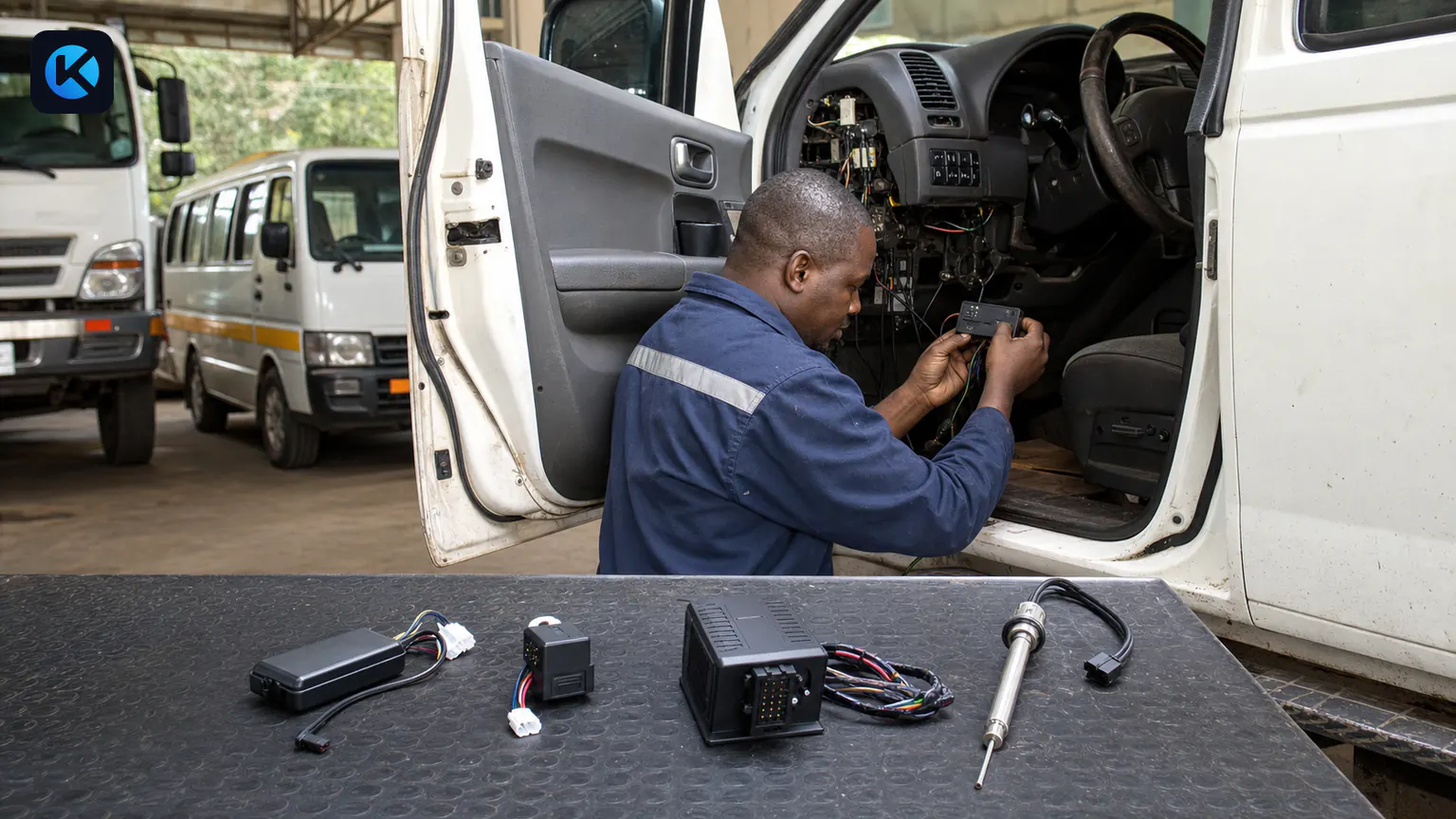
Search for a vehicle tracker in Kenya and you will find dozens of shops selling what sounds like the same box: "real-time tracking, engine cut-off, affordable price." The listings all blur together because they describe the device — not the job you need done. This guide sorts the market the useful way: by what each class of tracker can actually do, and what to check before money changes hands.
Kora builds software that can receive supported tracker data. This guide explains evaluation criteria; it is not a hands-on test of every device sold in Kenya or an independent ranking of suppliers.
The four classes of tracker sold in Kenya
Basic GPS tracker
Reports position, speed, and movement history over the mobile network. Answers "where is my vehicle?" and little else. The right tool for simple visibility on a private car or a small van — and the class most shops will sell you by default.
GPS tracker with immobiliser
Some devices support immobilisation through a compatible installation. Confirm the manufacturer’s safety conditions and an authorised recovery procedure; never assume a remote command is safe while the vehicle is moving.
CAN-connected telematics unit
Reads supported vehicle signals through a compatible interface. Odometer, engine hours, fuel data and diagnostics vary by vehicle and device; none should be promised without checking the supported parameters.
Fuel tank sensors
Compatible tank-level sensors can supplement GPS and fuel records. They require calibration and interpretation; an unexplained drop may indicate loss, a transfer, a leak or a measurement problem.
Choose only the signals needed for your work. More hardware is not automatically better value; a pilot should establish whether the extra information is usable and worth its installed cost.
The checklist before you pay for any of them
A working installation also depends on connectivity, support and data access. Ask each supplier the same questions:
- Total cost in four parts: device price, installation, SIM/data, and the monthly platform fee — insist on all four in writing
- Installer quality: a poorly hidden or poorly wired unit fails early and invites tampering
- Data access: can you export your own vehicle history, and what happens to it if you leave the provider?
- Platform reality: is there a usable app and web dashboard, or just SMS commands?
- Insurer and regulatory fit: confirm with your insurer which devices qualify, and check current NTSA guidance where it applies to your vehicle class
- Support: who answers when a unit goes silent, and how fast is a replacement fitted?
Already have trackers installed?
Kora works with supported tracking devices — the team reviews your current units and provider, confirms what can be connected, and recommends hardware only where you actually need it.
The question the tracker shops won't ask you
Here is the distinction that saves buyers the most money: a tracker is not a fleet system, and for a business, the dot on the map is the least valuable part of the data. What separates a tracked vehicle from a run operation:
- A tracker answers "where is the vehicle?" — an operating system answers "is the operation making money?"
- Dispatch, fuel logs, maintenance, driver settlement records, and document expiry all attach to the same vehicle the tracker locates
- Tracker data becomes evidence inside trips: distance driven against fuel filled, arrival against schedule
- You can start with records alone and add tracking later — or connect the trackers you already have
If you run one or two personal vehicles, a good tracker from a reputable installer is probably all you need. If vehicles are your business — cargo, PSV, school transport, hire — buy the tracker as the sensor, and put the operation itself on a system built to run it.
Frequently asked questions
What is the best vehicle tracker in Kenya?
There is no single best tracker for every vehicle. Define the job, confirm hardware and signal compatibility, compare installation and recurring costs, and test the output on your own vehicle. This article does not rank brands or report comparative product testing.
How much does a car tracker cost in Kenya?
Expect four cost components: the device itself, installation, a SIM or data plan, and a recurring platform fee. Basic GPS units are the cheapest class, immobiliser units cost more, and CAN telematics units and fuel sensors are the most expensive to buy and fit but return far more operational data. Prices vary widely between vendors and change over time, so compare complete written quotes — a cheap device with an expensive mandatory subscription is not cheap.
Do insurance companies in Kenya require a car tracker?
Tracker requirements and any premium adjustment depend on your policy and insurer. Obtain the required specification and any promised discount in writing before buying; a vendor’s claim is not an insurer’s commitment.
Can I use my existing tracker with fleet management software?
Often, yes. If your vehicles already have trackers installed, a fleet platform may be able to receive their data directly — it depends on the device model and who controls the server it reports to. The Kora team reviews your current devices and provider to confirm whether they can be connected, or recommends a supported device where they cannot.
What is the difference between a car tracker and fleet management software?
A tracker is hardware that reports where a vehicle is. Fleet management software is the system that runs the operation around that vehicle: dispatch and trips, fuel logs with anomaly flags, maintenance, driver settlement records, and document expiry tracking. A tracker without an operating system is a dot on a map; the value compounds when the dot is connected to the trips, fuel, and money.