
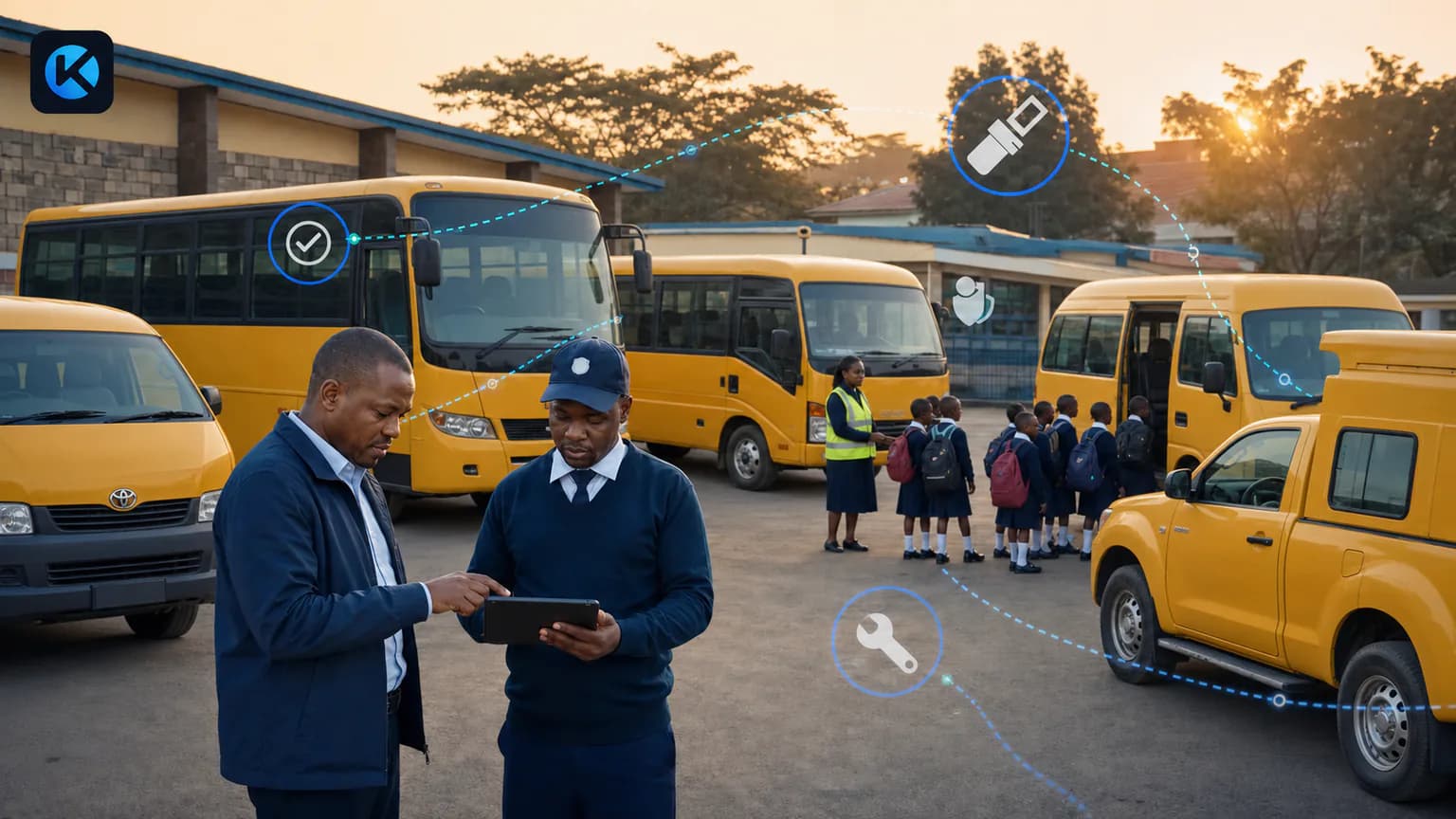
School transport requires clear vehicle, driver and route records. The 2026 regulatory changes also make it necessary to distinguish published rules from their current implementation; a blog or device seller cannot establish compliance simply by citing a commencement date.
Technology is only one part of the answer. A school still needs clear responsibility for vehicle readiness, driver records, route release, incident response, maintenance, and communication. Tracking helps when it sits inside that process; a map by itself does not create a safe or accountable transport operation.
This article is operational guidance, not legal advice. The implementation of new rules can change through official notices and transition guidance. Confirm current requirements directly with NTSA or a qualified adviser.
What changed with Kenya's school transport rules in 2026?
Kenya Law lists the Traffic (School Transport) Rules, 2026 as Legal Notice 11. The Ministry describes a framework covering licensing, safety, records and equipment. This review did not independently establish the effect of all later directions and proceedings as of 14 September 2026; the original text is not a verified statement of current enforcement.
The Ministry of Roads and Transport describes the framework as covering several connected operating areas:
- Licensing for school transport providers and individual school vehicles
- Vehicle safety standards, inspection, identification, and required equipment
- Driver, attendant, and crossing-guard responsibilities
- Insurance, maintenance records, route and passenger operating records
- Vehicle telematics and reflectorised stop-signal requirements
- Operating times, boarding procedures, permitted use, and incident reporting
For a school or independent provider, the practical lesson is simple: compliance evidence cannot live in one person's memory or a file cabinet that the transport desk rarely sees. The vehicle, driver, route, inspection, maintenance, and expiry records need clear owners and a repeatable review process.
Make school-route readiness visible before the bus leaves.
Kora offers shared fleet records with school-route terminology, tracking, maintenance and document visibility. Repeated daily runs still need operational validation; it is not a complete school transport or student-management product.
Start with a reliable vehicle and driver register
A transport team cannot control what it has not recorded accurately. Every bus or van should have one current record with registration, operating status, assigned driver, odometer, service posture, open defects, installed tracker, and document-expiry dates.
Driver records should make the relevant identity, licence, role, status, contact details, and expiry dates visible to authorised staff. Store uploaded documents privately and use time-limited access rather than public links. A school transport record may involve sensitive information, so access should follow job responsibility, not convenience.
Use a morning release check, not a last-minute phone call
The morning run is a high-pressure window. A short release check should tell the transport coordinator whether the planned vehicle and driver are ready before students begin boarding. At minimum, verify:
- The assigned bus or van is active and has no unresolved critical defect
- The driver is active and the relevant licence and identity records are current
- The correct school route and departure window are assigned
- Insurance, inspection, and other tracked vehicle documents have not expired
- Fuel and service readiness are sufficient for the planned morning and afternoon work
- The school office knows who owns any open exception before the vehicle leaves
If a critical defect or expired record blocks release, the system should make the reason explicit. The coordinator can then assign another ready vehicle or escalate the problem instead of discovering it after departure.
What should a digital school-route record contain?
A school route is not a freight trip. It should use school-route language and keep the record focused on movement, readiness, and exceptions. A useful operating record contains:
- School route, vehicle, driver, and planned departure time
- Expected student load or capacity context without unnecessary child data
- Actual departure, route-close time, and material delays
- Vehicle location and movement history where tracking is enabled
- Defects, incidents, route notes, and follow-up ownership
- Fuel and odometer context needed for vehicle control and maintenance
Keep data collection proportionate. An operations platform can manage the bus, driver, route, expected load, and movement record without becoming a student information system. Student attendance, named passenger manifests, and guardian communication require their own product and privacy design; do not assume a fleet platform includes them.
Evaluate school-vehicle telematics as an operating system, not a gadget
Telematics combines a vehicle device, connectivity, location or sensor data, ingestion, storage, and a workspace where authorised people can act on the information. Buying a tracker without defining the operating workflow creates another screen to watch rather than a control system.
Ask these questions before selecting or installing a system:
- Does the device provide reliable location updates on the routes the school actually operates?
- Can the team distinguish live, delayed, and offline vehicle positions?
- How does the system behave when Safaricom or mobile data coverage drops?
- Who can access location history, and is access limited to authorised staff?
- Can the provider explain hardware, installation, connectivity, and data-retention terms separately?
- Does the proposed device and installation meet current NTSA and applicable technical requirements?
Kora can receive live vehicle positions and supported telemetry from compatible installed trackers, but a school should independently confirm that a proposed device, installation, and data setup meet the current technical and regulatory requirements. Hardware, installation, and managed connectivity should also be scoped transparently rather than hidden inside a software claim.
Connect inspections to maintenance work and vehicle availability
A checklist has little value if a defect is recorded and then forgotten. When a driver or transport coordinator reports a safety issue, the workflow should keep that issue tied to the vehicle, create maintenance work where necessary, assign an owner, and record the repair outcome.
Service intervals should use current odometer or date context, not memory. The transport coordinator needs to know which vehicles are approaching service, which are in the workshop, which are waiting for parts, and which are ready for the next route. That same view helps the school plan substitutes before a breakdown disrupts the morning run.
Build an incident record that survives beyond the phone call
A delay, breakdown, collision, or route safety concern needs a durable record: time, vehicle, driver, route, location, description, evidence, response owner, and resolution. The first priority is always people and immediate safety. The operating record comes next so the school can coordinate recovery and later understand what happened.
Keep communications factual. A location trail or timestamp can support the review, but it does not explain intent or assign blame. Use the evidence to reconstruct the event and improve the process—not to make automated conclusions about the driver.
A practical 30-day school transport improvement plan
Do not begin with a fleet-wide hardware purchase. Begin with accurate records and one route that the team can operate consistently. Over the next 30 days:
- Create one accurate register of every school bus, van, driver, and key expiry date
- List every open defect and close or formally schedule each item
- Define the morning release and afternoon closeout owners
- Map every route, vehicle assignment, and expected operating window
- Confirm current licensing, inspection, equipment, and telematics guidance with NTSA
- Pilot the workflow on one route before rolling it across the whole school fleet
The pilot should answer operational questions: Did the vehicle leave ready? Could the school see the movement status? Were exceptions captured? Did defects reach maintenance? Could the team find the right documents without searching? Expand only after those basics work reliably.
Frequently asked questions
What do the Kenya Traffic (School Transport) Rules, 2026 cover?
The published 2026 instrument addresses school transport licensing, safety, staffing, records and equipment. Its published text must be distinguished from later implementation directions. This review did not establish the current effect of every disputed provision through 14 September 2026.
When did the 2026 school transport rules take effect in Kenya?
Do not treat a date in the original instrument as proof that every requirement is currently enforced. NTSA lists an implementation clarification dated 28 June 2026, and the Senate debated an annulment motion on 11 June with voting deferred in that sitting. Confirm the current position for the specific provision before relying on a deadline or exemption.
What should school bus tracking software show?
School bus tracking software should show the assigned vehicle and driver, the planned school route, whether the position is live or delayed, movement history, route start and close times, and operational exceptions. It should also limit location access to authorised staff and remain useful when connectivity is unreliable.
Does Kora Fleet include a parent app or student manifest?
No. Kora offers school-oriented fleet records, vehicle tracking, maintenance, fuel review and documents. Parent apps, guardian alerts, student attendance and manifests are not provided. Repeated daily route scheduling remains a workflow to validate before rollout.
Can fleet software guarantee school transport compliance?
No. Fleet software can organize vehicle, driver, route, maintenance, incident, tracking, and expiry records, but it does not issue licences, perform inspections, certify equipment, or guarantee legal compliance. Schools and providers remain responsible for confirming and meeting current requirements.
Official sources and further reading
Read the published instruments and confirm current implementation guidance directly with the relevant authority before making legal or procurement decisions.