
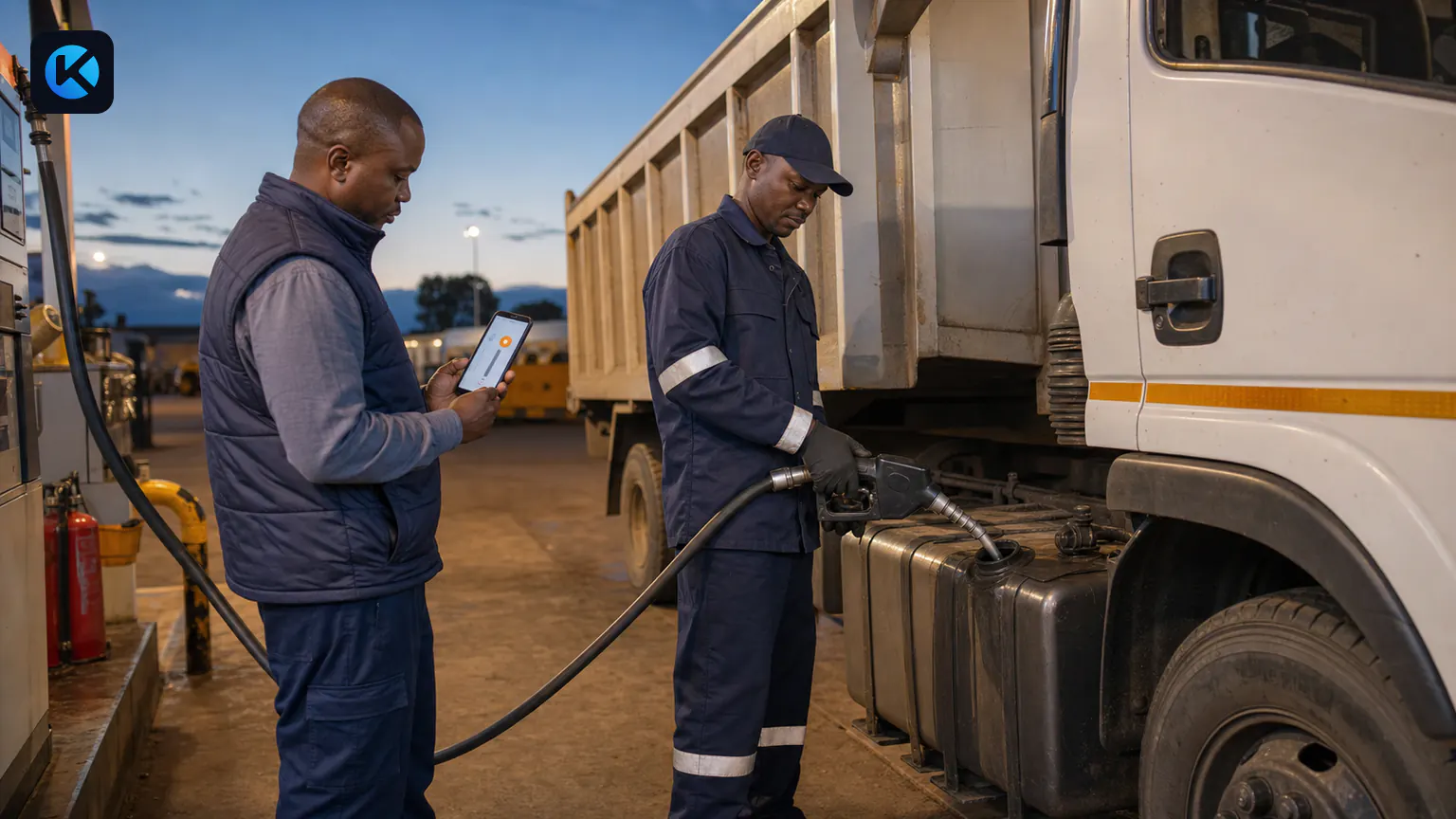
An unexplained rise in fuel cost needs a careful investigation. Start by separating higher prices, increased workload and measurement errors from physical loss. A rising bill alone does not establish theft.
One thing should be said honestly up front: no software makes a fleet theft-proof, and anyone promising that is selling you a story. What you can do is make fuel loss visible, fast to catch, and expensive to attempt through consistent records and independent review. This is a proposed operating method, not a measured theft-reduction result.
Why the monthly fuel total hides everything
Monthly totals are useful for budgeting but can conceal individual discrepancies unless the underlying purchases remain available for review:
- A monthly fuel bill mixes every vehicle, route, and driver into one number nobody can interrogate
- A single inflated receipt or short fill disappears inside thousands of legitimate litres
- By the time the number looks wrong, the trips involved are weeks old and unprovable
- Confronting a driver with a suspicious total — and no evidence — poisons trust either way
How diesel actually leaves a fleet
Examples to consider during an investigation:
- Short filling: paying for a full tank at the pump but filling only part, with the receipt showing the full amount
- Receipt inflation: a receipt written for more litres or a higher price per litre than was actually dispensed
- Siphoning: fuel drawn out of the tank after filling — at a stopover, overnight parking, or with the vehicle idle
- Route padding: unnecessary kilometres or private detours that burn company fuel outside the trip
- Station collusion: an attendant and driver splitting the difference on litres that never entered the tank
Notice what every pattern has in common: each one leaves a trace in the relationship between litres, money, odometer, and time. A complete record can support investigation; it cannot expose or prevent every form of loss.
Make every fill answer for itself.
Kora lets authorised workspace staff record fuel purchases, odometer readings and receipts. Supported anomaly checks route exceptions for human review. Fuel-accounting entry is not a driver-app feature.
The fix: per-fill discipline
The control is not a gadget — it is a record with the right shape. Every fill becomes a small, checkable transaction:
- Capture each purchase with station, litres, unit price and receipt; in Kora this accounting record is entered by authorised workspace staff
- The odometer reading is captured with the fill, so every litre is tied to the distance it should cover
- Compare purchases with recorded tank capacity; estimating remaining space also requires a trustworthy opening level
- Consumption is compared against the vehicle’s own baseline, not a generic figure
- Rapid back-to-back refills and mileage mismatches raise flags for review
- Flagged fills land in a review queue with the evidence attached — readings, receipt, history — for a human decision
Give a named person responsibility for reviewing the queue. A flag can reflect a faulty odometer, a price change, a partial fill or a legitimate extra stop. Document the evidence and outcome; the system’s alert is not a verdict.
Tank sensors: useful, but know what works in Kenya
Measured fuel closes the gap paper cannot: what happened to the tank between fills. But the hardware picture is more nuanced than vendors admit:
- Supported CAN interfaces may read distance, engine hours and fuel data; verify the available parameters on each vehicle
- CAN fuel-level availability and accuracy depend on the vehicle, interface and installation
- A compatible, calibrated tank sensor is an option where direct level measurement is needed
- A sustained unexplained level drop can prompt investigation; a leak, transfer, slope or sensor fault must also be considered
- Sensor data supplements the paper trail; the per-fill log remains the foundation either way
The part that protects your drivers
Use the same documented controls for everyone. Accurate records can support a driver’s explanation as well as reveal discrepancies, but apparently consistent numbers do not prove that nothing went wrong. Explain monitoring, restrict access and provide a way to challenge errors.
A 30-day plan to get control of fuel
- Pick one route or a handful of vehicles — not the whole fleet — and start logging every fill with an odometer reading
- Record tank capacity and collect enough complete, comparable measurement windows to establish a baseline; two weeks is not a universal minimum
- Route every flagged fill to one named reviewer with the authority to ask questions
- Brief drivers openly: the record is company policy for every vehicle, not suspicion of any person
- Compare the pilot group’s cost per kilometre before and after — then expand vehicle by vehicle
- Only after the record is running, evaluate tank sensors for the vehicles where the numbers justify them
Start small and let the numbers make the case. The comparison that convinces an owner is not a vendor demo — it is the cost per kilometre of the pilot vehicles, before and after the record existed.
Frequently asked questions
How do I know if a driver is stealing fuel?
Fuel discrepancies are not proof that a driver stole fuel. Check the purchase, tank level, measurement window, route, payload, auxiliary use and sensor accuracy. Review corroborating evidence and the driver’s explanation before taking action.
How can a Kenyan transport company stop diesel theft?
No system makes theft impossible. Complete purchase records, controlled access, independent reconciliation and timely human review can help investigate unexplained loss. Do not treat a software alert as a finding of misconduct.
Do fuel sensors work on trucks in Kenya?
Compatibility depends on the vehicle, tank, device and installation. Compare supported CAN readings with a calibrated tank sensor where needed. Neither a position trace nor a single level drop establishes theft.
What is normal fuel consumption for a truck in Kenya?
There is no universal figure. Compare complete measurement windows for the same vehicle doing similar work. Kora uses recorded vehicle efficiency and available history in supported checks; do not assume that software automatically learns a statistically reliable baseline from every fill.
Does GPS tracking stop fuel theft?
GPS alone does not — it shows where a vehicle is, not what happened to its fuel. Position history helps explain route padding and unexplained stops, but catching short fills, inflated receipts, and siphoning requires fill records reconciled against odometer readings and tank capacity, plus measured tank levels where sensors are fitted. Tracking is one input; the fuel record is the control.