
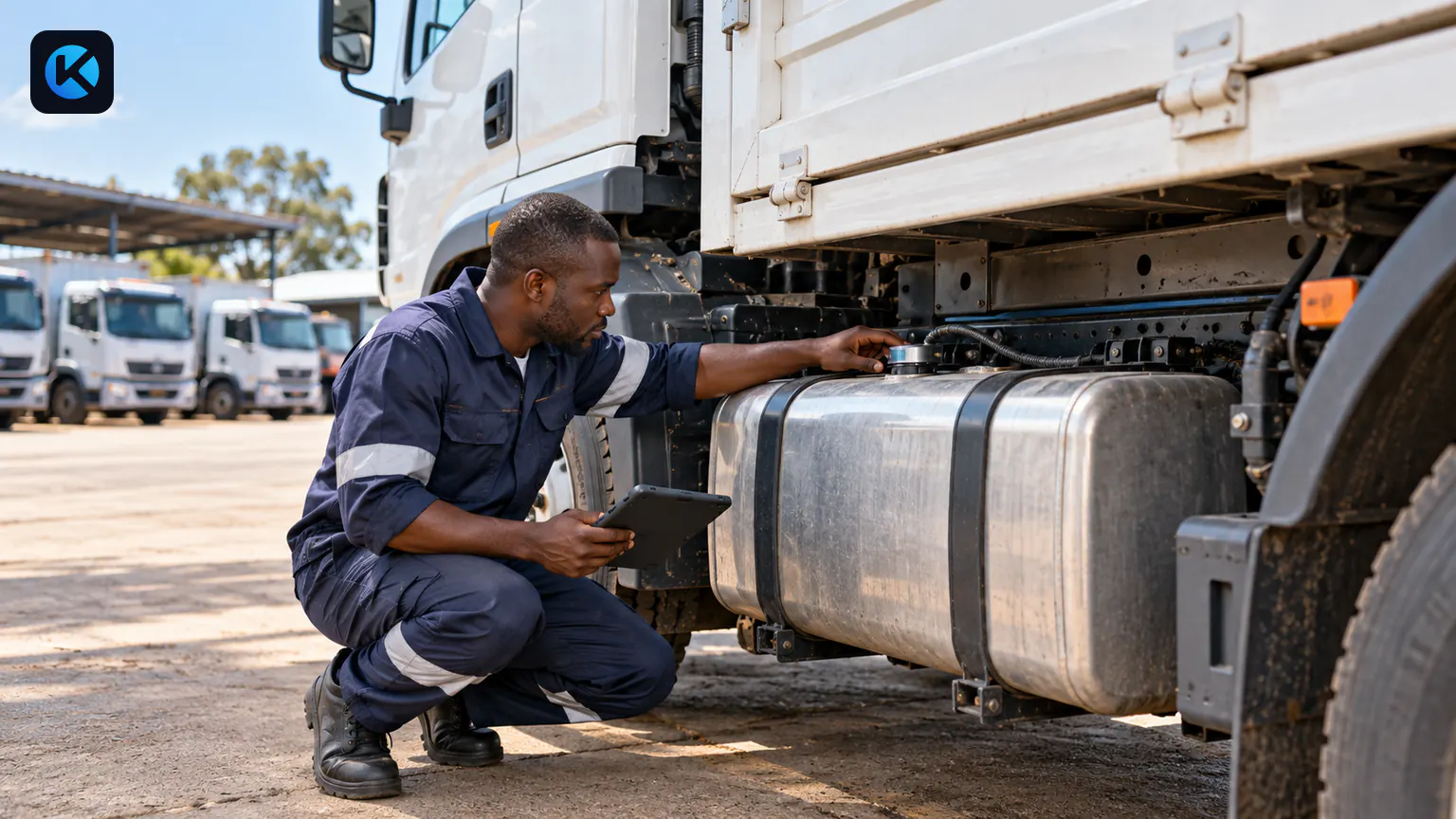
Fuel can be a substantial fleet cost. EPRA’s pricing framework sets maximum retail prices for regulated products, rather than requiring every station to charge the same amount. Monitor both the actual price paid and litres using complete purchase records and a consistent measurement window.
This guide is vendor-neutral on hardware. It describes how the measurement actually works so you can judge any supplier's claims, including ours.
Three sources of fuel truth, and what each one is worth
These are three useful input types to compare. A system may also use validated engine fuel-used counters or flow measurement. Establish which signals the installation actually provides and how they are reconciled.
1. Fill records and receipts
- Records a claimed purchase; reconcile it with payment evidence and the supplier’s record
- Does not prove those litres entered this vehicle's tank rather than a jerrican, another vehicle, or nothing at all
- Needs verification against independent purchase and vehicle records
- Purchase records remain essential for reconciling billed litres and cost; direct engine fuel-used data, where supported and validated, can also measure consumption
A receipt records a purchase claim; it does not independently establish payment, delivery into a particular tank or consumption. Reconcile it with the payment record, supplier information and vehicle measurements.
2. CAN bus data from the vehicle
- CAN can supply vehicle-reported distance, running time and fuel parameters where the vehicle and interface support them; check the available signals per model
- Usable tank-level reporting depends on the vehicle, supported CAN parameters and interface
- Do not infer compatibility from a make or age alone; ask for the supported-vehicle list and test the actual installation
- A telematics reader can collect vehicle-reported data without manual entry, but that data is not immune to faulty sensors, resets or tampering
- Verify on your actual vehicles before committing. A demo on a European tractor unit tells you very little about your Isuzu or Hino
CAN data can reduce manual entry, but it is not tamper-proof and available parameters vary. Ask the supplier to demonstrate usable signals on your vehicle makes before you build a programme on it.
3. An in-tank fuel level sensor
- Fitted into the tank itself, so it reports level independently of what the vehicle chooses to publish
- A compatible tank sensor can work independently of the vehicle CAN bus, subject to tank design and installation constraints
- Requires proper installation and calibration against the specific tank — an uncalibrated probe produces confident, wrong litres
- Account for secondary tanks and separately fuelled trailer or auxiliary equipment
- Evaluate calibrated tank sensors where CAN level data is unavailable or unsuitable; compare accuracy and installed cost on your vehicles
A compatible probe measures tank level independently of the vehicle’s CAN reporting. It still requires suitable installation, calibration and checks for fuel movement, tank geometry and sensor error. Compare it with supported CAN readings on the same vehicle before selecting a solution.
Fuel accountability without a fuel screen in the cab.
Kora lets workspace staff record fuel purchases with vehicle, odometer, unit cost, station and receipt details. Supported checks raise exceptions for review. Drivers do not enter fuel-accounting records in the field app.
Calculate consumption over a consistent window
For a purchase-based calculation, match distance with fuel used over the same interval. Starting and ending at a consistent tank level makes all intervening fills meaningful; partial fills without level reconciliation do not measure consumption on their own.
- Distance covered within the chosen measurement window, from a checked odometer or telemetry source
- All litres added during that same window, adjusted for opening/closing level differences and transfers
- Consumption for a window with consistent opening and closing levels, including all fills, transfers and auxiliary usage
- The vehicle’s baseline from comparable routes, payloads and measurement windows
- The variance between the two, and whether it is large enough and repeated enough to be a signal rather than noise
The critical word in that list is baseline. Build it from complete records and comparable work. Manufacturer data can provide context but is not a guaranteed result on your routes. Distinguish loaded and empty running, idling and auxiliary equipment use.
The question that separates a system from a dashboard
Tank readings can change with road slope, fuel movement, sender behaviour and calibration. Evaluate the actual installation under the conditions in which the vehicle works, including stationary readings.
A single noisy level reading can create a false alert. Evaluate a window of readings, check for a sustained change and compare it with vehicle movement and engine context before raising a flag for human review.
Ask any vendor directly how they handle sender noise and stationary-versus-moving context. The answer tells you whether you are buying a monitoring system or a chart.
What the flags should look like
A useful fuel programme produces a short, specific queue of things a human should look at — not a wall of readings. In practice that means a small set of named conditions:
- Excess fill — more litres added than the tank can physically hold
- Mileage mismatch — the distance covered does not support the litres claimed
- Rapid refill — two fills close together with little distance between them
- Suspected siphoning — a level drop that does not correspond to running
- Missing receipt — a fill recorded with no supporting document after a reasonable window
Every one of those is a question, not an accusation. Vehicles get topped up before a long run, senders fail, receipts get lost, and a genuinely heavy load burns more. The value is that the question gets asked within days, against a specific vehicle and a specific fill, instead of surfacing as an unexplained monthly total nobody can reconstruct. For the human side of that conversation, see the practical guide to stopping diesel theft in a Kenyan fleet.
Who should own the fuel record
Separate evidence collection from approval. A driver-supplied receipt can be useful, but reconcile it with purchasing records and available telemetry instead of relying on one person’s account alone.
In Kora, authorised workspace staff maintain fuel-accounting records and review exceptions. Explain to drivers what telemetry is collected, its purpose, who can access it and how disputed readings are reviewed. Independent review does not require secret monitoring.
Transparent monitoring and independent reconciliation help a team investigate discrepancies fairly. Further examples appear in the hidden fuel leaks in a transport business.
Before you buy anything
Four questions, in order. What does this read on my vehicle makes — verified on one of my trucks, not a demo unit? Where does distance come from, and can a driver influence it? How does the system separate real level changes from road noise? And when it flags something, who reviews it, and what happens next?
Ask for evidence supporting each answer and compare the installation against your requirements. A graph alone does not establish measurement accuracy or an effective review process. If you are choosing hardware, the guide to vehicle trackers in Kenya covers what each class of device does before fuel enters the picture.
Frequently asked questions
What is a fuel monitoring system?
A fuel monitoring system tracks how much fuel a vehicle receives and how much it consumes, then compares the two against the distance covered. In practice it combines three inputs: fill records showing litres purchased, distance and engine hours from the vehicle, and a tank level reading from either the vehicle's own data or a sensor fitted in the tank. Discrepancies between what was bought and what the work required are flagged for a person to review.
Do I need a fuel sensor, or is CAN data enough?
Verify the vehicle, tracker, interface and available parameters together. CAN may provide distance, engine hours, fuel level or fuel used, but not every vehicle supplies every signal. A calibrated tank sensor is an alternative where direct level measurement is needed.
How does a fuel monitoring system detect diesel theft?
It does not detect theft directly — it detects discrepancies that theft produces. A level drop while the vehicle is stationary and not running, litres claimed that the distance covered cannot justify, a fill larger than the tank can hold, or repeated fills with no mileage between them all become visible. Each one is a flag for a human to investigate, not a verdict. No system makes a fleet theft-proof; the point is to make loss visible quickly and expensive to attempt.
Should fuel reviews track price as well as litres?
EPRA sets maximum retail prices for regulated fuels; this is a ceiling, not a uniform transaction price. Location, pricing period and purchasing terms matter. Record the actual unit price as well as litres, then separate price changes from consumption changes.
Should drivers record fuel fills themselves?
Drivers may provide receipts under an operator’s process, but one person should not both supply and approve all evidence. Kora fuel accounting is handled in the workspace. Reconcile purchases with independent readings, disclose monitoring to drivers and have a named reviewer investigate exceptions.
How accurate does a fuel monitoring system need to be?
Accurate enough to separate a real loss from normal variation, which is a lower bar than perfect litre-level precision. Fuel moves in a tank on rough roads, and a single reading can be misleading in either direction. What matters is whether the system judges trends over a window rather than reacting to individual readings, and whether the flags it raises turn out to be worth investigating. A system that cries wolf gets ignored, and an ignored system controls nothing.